This guide is for internationals who have just moved to Germany and want to understand the Opportunity Card, the residence permit that lets qualified people stay and look for work. After reading, you will know who can get it, how the points system works, how long the card lasts, what work it allows and how to apply.
- What the Opportunity Card is
- Who can get it
- The points system
- Working and supporting yourself
- How to apply
- How long it lasts and what comes next
- FAQ
What the Opportunity Card is
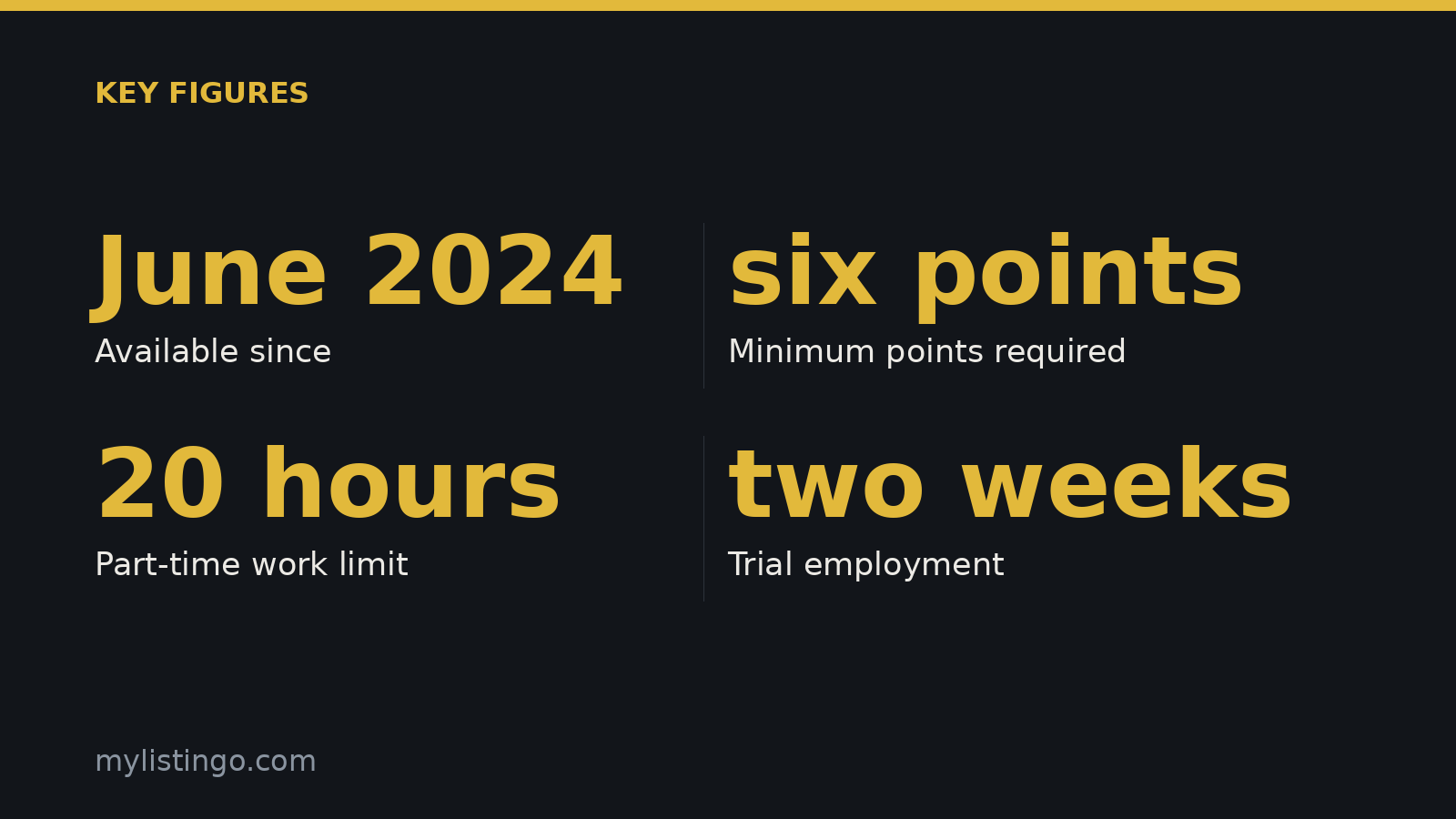
The Chancenkarte (Opportunity Card) is a residence permit for skilled workers under Sections 20a and 20b of the Residence Act (Aufenthaltsgesetz). According to Handbook Germany, it has been available since June 2024 and gives holders the chance to look for a job in Germany. No job offer is needed before entering.
It can also act as a bridge for people already here. Someone who loses their job, and with it their residence permit, can obtain a Chancenkarte to stay and look for another job. It is not the same as the Chancenaufenthalt (opportunity residence under Section 104c), which is a route for asylum seekers in Germany.
Who can get it
There are two routes. Third-country nationals who count as skilled workers under Section 18(3) of the Residence Act receive the card without special additional requirements. To count as a skilled worker, a person must prove that their foreign qualification or university degree is recognised in Germany.
Everyone else must meet three conditions:
- basic German (A1 CEFR) or English (B2 CEFR);
- at least six points in the points system;
- a foreign university degree, or a professional qualification obtained after at least two years of training and recognised in the country of training, or a qualification issued by a German Chamber of Commerce Abroad.
The Central Office for Foreign Education (ZAB) must confirm that a professional qualification took at least two years of training. It must also confirm that the qualification or degree is state-recognised in the country where it was obtained. Applicants pay for this procedure themselves, and the page does not state the fee. The “Self-Check: Chancenkarte” on the Make it in Germany portal lets people test their eligibility.
The points system
Applicants who are not skilled workers need at least six points:
- 4 points: full or partial recognition of a foreign professional qualification, or permission to practise a regulated profession (for example educator, nurse or engineer).
- 3 points: at least 5 years of professional experience within the last 7 years after completing two years of vocational training, or good German (B2).
- 2 points: sufficient German (B1), or 2 years of professional experience in the last 5 years after completing vocational training, or being no older than 35.
- 1 point: basic German (A2); at least 6 months in Germany in the last 5 years, not as a tourist; being between 35 and 40; very good English (C1); a qualification in a shortage occupation; or applying together with a partner who meets the requirements.
For shortage occupations, only the occupation numbers 132, 133, 134, 21, 221, 222, 225, 226, 23 and 25 in the official list count. Every cardholder has the same rights whatever their score, and the score is not recorded on the card.
Working and supporting yourself
Holders must be able to secure their livelihood during their stay. While searching, the card allows part-time work of up to 20 hours a week, which can help cover costs. It also allows two weeks of trial employment with an employer, but this must be qualified and training-oriented.
Another way to show funds is a Sperrkonto (blocked account). It must hold at least €1,091 (2026) for each month the person plans to spend in Germany on the card. The money stays blocked until arrival. Withdrawals are capped at €1,091 a month unless more than the minimum was deposited. If someone does not have enough money, a third person can sign a declaration of commitment on their behalf.
How to apply
The card can be applied for from abroad, and the German consulate decides on the entry visa. A visa may be refused even with six points. For people already in Germany, the page does not describe the procedure or name the responsible office. Residence matters are handled locally by the Ausländerbehörde (foreigners’ authority), and practice can differ between cities and federal states. That office, or a migration advice service, can answer questions about an individual case.
How long it lasts and what comes next
The card is first granted for up to 1 year. A holder may not have obtained a work-based permit under Sections 18 to 21 by then. In that case the card can be extended for a maximum of another 2 years, but only with an offer for a qualified job approved by the Federal Employment Agency (Bundesagentur für Arbeit). During the extension, holders may only do the job stated on the work permit and may not take part-time work in another job. The extended card cannot be extended again.
There is no direct switch from the card to a permanent residence permit. Holders must first move to another residence permit. The years on the card do count towards the residence period needed for permanent residence. After the card expires, a new one can only be applied for after a gap at least as long as the old card’s validity. During that gap, the person needs another permit or must stay abroad.
Family reunification follows the general rules, such as a secure livelihood, enough living space and, where needed, language skills (A1 for spouses, C1 for children over 16). The holder’s permit must be valid for at least 1 year when the spouse applies. The page notes that this can be difficult with a card first issued for 1 year. Couples can apply together, and each partner may gain a point by doing so.
FAQ
Can I apply for the Opportunity Card from inside Germany?
The page states that the card can be applied for from abroad. It also says that people who lose their job and residence permit in Germany can obtain one to stay. It does not describe the in-country procedure, so the local Ausländerbehörde or a migration advice service is the place to ask.
Does reaching six points guarantee a visa?
No. An entry visa may be refused even with six points. The decision rests with the German consulate handling the application.
Can I work full-time with the Opportunity Card?
Not while searching. The card allows part-time work of up to 20 hours a week and two weeks of qualified, training-oriented trial employment. During an extension, only the job on the work permit is allowed.
How much money is needed in a blocked account?
At least €1,091 (2026) for each month the holder plans to spend in Germany on the card. Monthly withdrawals are capped at €1,091 unless more than the minimum was deposited. A third person can sign a declaration of commitment instead.
Sources: handbookgermany.de
Last verified: 14 October 2026 against the pages linked above. Rules and fees change; the responsible authority always has the final word.
This is general information, not legal or immigration advice. For your own situation, ask the foreigners’ authority (Ausländerbehörde) of your city, a recognised migration advice service or a lawyer (Rechtsanwalt).
Sources
- handbookgermany.de: “Opportunity Card” for Jobseekers, accessed 14 October 2026
Germany, for internationals
One email a week: the week's news for internationals in Germany, new practical guides and what changed in the cities. No spam, unsubscribe any time.